
Is Ethiopia Safe to Visit in 2026? October Travel Advice & South Ethiopia Travel Guide

Important safety disclaimer
Please do not use this article as your only source of information when deciding whether to travel to Ethiopia. The security situation can change quickly. Always check your own government's latest travel advice, speak to your local guide or tour operator shortly before travelling, and make sure your travel insurance covers your planned trip and destination.
Government travel advice also differs significantly between countries. Some governments advise against travel to large areas of Ethiopia, while others distinguish much more clearly between the conflict-affected north and other parts of the country.
This article reflects the situation and information available to us on 8 October 2026. We live and work in Ethiopia and speak to people on the ground regularly, but we cannot guarantee anyone's safety or predict what may happen in the future.
Is Ethiopia safe to visit right now?
Yes, southern Ethiopia, including the South Omo Valley, is currently a safe and very good alternative to travelling in northern Ethiopia. The conflict that is affecting parts of northern Ethiopia is geographically very far from South Omo, and South Omo has no connection to the current fighting. Northern Ethiopia is not currently safe.
I know that it is scary when the news announces that there is a war in Ethiopia, and it is absolutely right to research into the situation before travelling.
It is however, unhelpful when news headlines say simply “Ethiopia is at war”, because Ethiopia is a huge country and the current conflict is concentrated in particular parts of the north.
The UK government currently advises against all travel to Tigray and Amhara, as well as a number of specific areas elsewhere in Ethiopia. At the same time, its travel advice does not advise against travel to most of South Ethiopia.
Other governments take a more cautious overall approach. The US takes a cautious approach as they always issue a blanket statements for whole countries and they currently advises travellers to reconsider travel to Ethiopia, while specifically advising against travel to a number of particular areas, including Tigray and some areas of South Ethiopia.
So rather than asking “Is Ethiopia safe to visit?”, the more useful question is:
“Which parts of Ethiopia are currently safe for me to travel to?”
And that is a better question.
Because saying the whole of Ethiopia is unsafe is a little like saying there are riots in Edinburgh, Scotland, so you won't go to Nice in the South of France. Ethiopia is enormous, and what is happening in northern Ethiopia is a very long way from South Omo.
South Omo is not part of the current northern conflict. It has its own local communities, geography and political situation, and there is no current fighting there connected to the conflict in the north. It was also not affected by the 2020–2022 Tigray war.
Whether you already have a northern Ethiopia trip booked or you are simply thinking about visiting Ethiopia in late 2026 or 2027, South Omo is one of the best parts of the country to consider. If your original plans included northern Ethiopia, you don't necessarily need to cancel your Ethiopian holiday altogether. And if you haven't booked anything yet, this is a great time to plan a trip around the South Omo Valley, rather than treating it simply as an alternative.
How do you know it is safe in southern Ethiopia?
Although I am British, I live in the South Omo Valley, and spend time in Addis Ababa frequently. During the conflict, I flew back here from a short break in the UK with my 2-year-old son and I would not be putting him at any risk.
My Ethiopian husband and I run a tour company, so we have contacts across Ethiopia. We are constantly checking in to get the most up-to-date information for our guests.
It means that we are in a much better position than someone reading a headline about “war in Ethiopia” to understand what is actually happening in the places our guests are travelling.
So where actually is unsafe?
Currently, the main concern is northern Ethiopia.
The UK FCDO currently advises against all travel to Tigray and Amhara, which includes places such as Mekelle, Axum, Gondar and the Simien Mountains. It also advises against travel to a number of specific areas elsewhere in Ethiopia.
Flights to and from Tigray have also been suspended, and flights to northern Ethiopia could be suspended or cancelled at short notice.
Lalibela is more complicated. The situation there can change quickly, so we would not currently recommend simply assuming that because you have a Lalibela booking, you should go ahead with it. Check with us and your own government travel advice before travelling.
The important thing is that you should not assume that an itinerary containing northern Ethiopia means your entire Ethiopian holiday needs to be cancelled.
If you have already booked a trip to the north, get in touch with us. We can look at your existing itinerary and see what could be moved south. Bookings@ethicalethiopia.com
Should I cancel my trip to Ethiopia?
Why don't you consider the South of Ethiopia instead?
If you have already booked flights and accommodation for northern Ethiopia, it can be incredibly frustrating to lose the money you've paid and cancel your entire holiday.
Instead, you could change your itinerary and explore a completely different side of Ethiopia.
And honestly, South Omo shouldn't just be thought of as a backup plan. For many travellers, it is the highlight of their entire Ethiopia trip. The landscapes are extraordinary, the cultural diversity is huge and the experiences are much more immersive than simply visiting a famous historical site for an hour or two.
There are currently far fewer tourists in southern Ethiopia than there would normally be, which means you can experience places that already feel remote without the usual crowds.
Already booked your flights? Don't cancel them yet. If you book your replacement tour with us, send us your Ethiopian Airlines flight details and we will handle the administration of rearranging the domestic flights needed for your new southern itinerary.
So you don't necessarily have to start again from scratch.
Email us and tell us what you have already booked, and we can see what we can do: Bookings@ethicalethiopia.com
And if you haven't booked your trip yet, you don't need to wait for the situation in northern Ethiopia to change. You can simply plan your Ethiopian holiday around the South from the beginning – just get in touch!
What can I experience in the South of Ethiopia?
Quite a lot.
This is the part of Ethiopia that gets missed when people think of the country as Lalibela, Gondar, the Simien Mountains and the Danakil Depression.
And we think that is a shame.
South Omo Valley

The South Omo Valley is one of the most culturally fascinating parts of Ethiopia.
It is home to many different ethnic groups, including the Hamar people, who have held onto traditions and ways of life that are very different from those in the cities.
This is what we specialise in. We have spent years building relationships with Hamar families and community members, so our experiences are not something we can simply buy from a local supplier and add to an itinerary.
We don't take people to a staged “tribal village” for ten minutes of photographs and then drive away.
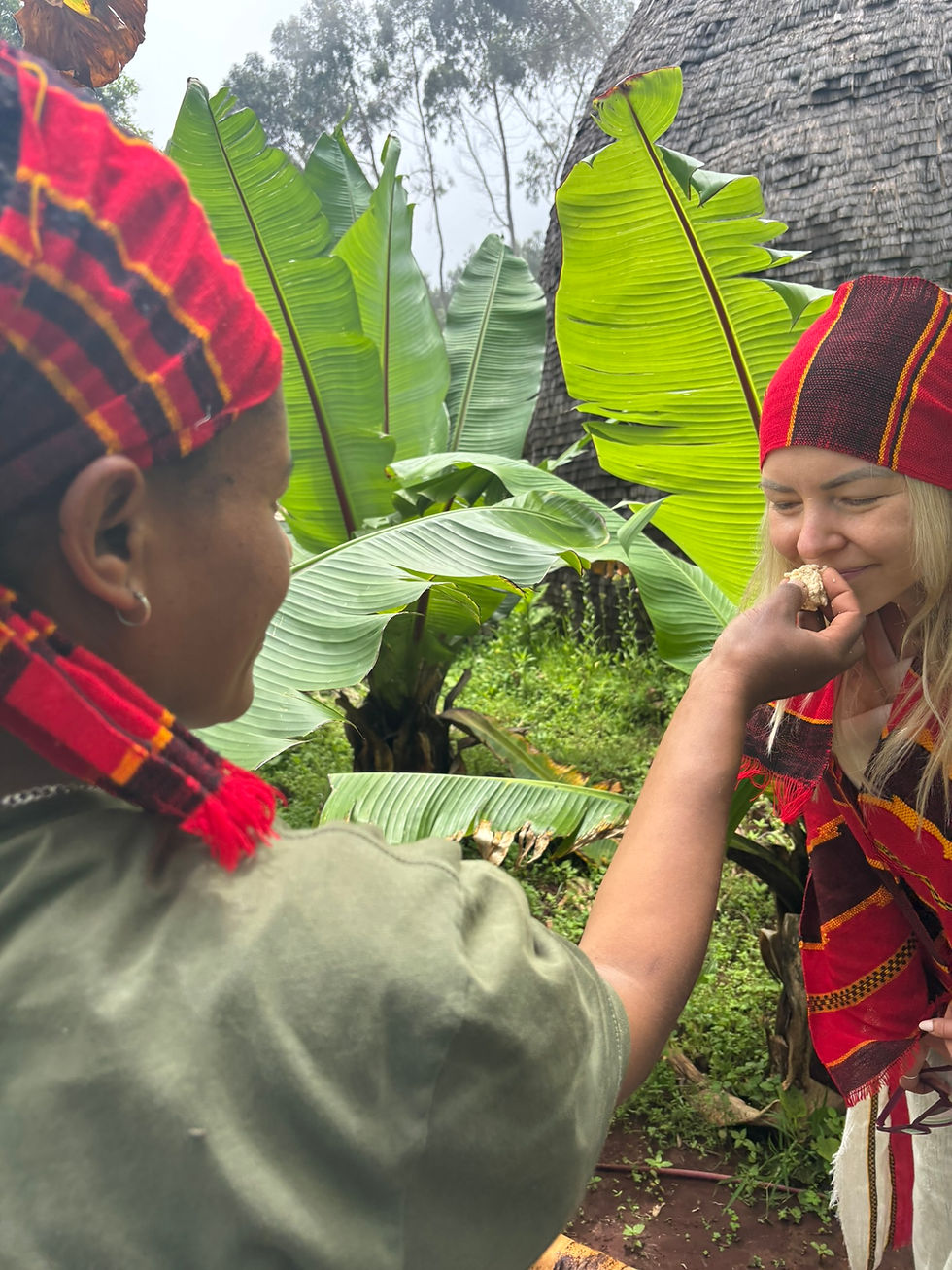
Our Hamar experiences are about actually spending time with people and learning about everyday life.
Depending on your trip, you can:
Spend time in a Hamar village and learn how families live, cook and work
Join a local family for a traditional coffee ceremony
Learn to make jewellery with Hamar women
Cook and share food with local people
Learn about farming, honey harvesting and everyday life
Spend the night in a Hamar village, either camping or sleeping traditionally inside a house
Learn about the stars and traditional knowledge passed down through generations
Visit local markets
If the timing is right, experience a Hamar bull-jumping ceremony*, with a proper explanation of what you are watching and why it matters
Take part in an evening of Evangadi dancing if one is taking place
*Bull jumping isn't something that happens every day and ceremonies are arranged around individual families, so we never promise it as a guaranteed tourist attraction. We check what is actually happening locally. (October and November is bull-jumping season so it is likely you can see one then)
This is also why travelling with someone who has genuine long-term relationships in the area makes such a difference.
We have been working with Hamar communities for years, and our relationships are the reason we can offer experiences that go much deeper.

Arba Minch
Arba Minch is another excellent alternative if your original itinerary included northern Ethiopia.
Here you can visit the Dorze people, learn how traditional houses are made, see how food is prepared, experience dancing and spend time learning about everyday life.
You can also make the trip more luxurious if you want to.
There are beautiful places to stay overlooking the lakes, including a newly opened lodge with individual pools, which makes Arba Minch a great place to slow down for a couple of nights.
There are also boat trips on Lake Chamo, where you can see crocodiles and hippos, trips to natural forest springs where you can swim and potentially see monkeys. You an even head further into the surrounding national parks and see wildlife such as zebra and warthogs.
Bale Mountains
If you were planning to visit the Simien Mountains, Bale is a great alternative.
Bale is completely different from the Simien landscape, but it is one of the most extraordinary places in Ethiopia for wildlife and landscapes.
It is one of the best places in the world to see the Ethiopian wolf, as well as mountain nyala and the endemic Bale monkey. It also has some of the best birdlife in Ethiopia, with many Ethiopian endemic species.
You can explore the Sanetti Plateau, walk through high-altitude landscapes, visit the Harenna Forest and look for wildlife.
And if you want something completely different, you can combine Bale with Sof Omar Caves.
Sof Omar is one of the longest underground cave systems in Africa. The caves have huge cathedral-like chambers, narrow passages, a river running through them and bats overhead. It is a completely different experience from the Danakil Depression, but that's exactly the point.
Lake Langano
For some time to relax, there is Lake Langano.
The lake is famous for its unusual grey sand beaches and mineral-rich water, and it is one of the few lakes in Ethiopia where visitors commonly swim.
You can spend time on the beaches, swim, walk around the lake and simply slow down for a couple of days.
It is a great place to add after a busy South Omo trip.

Hawassa
Hawassa is a relaxed lakeside city with good hotels and resorts, a beautiful lake, fresh fruit and one of the most famous fish markets in Ethiopia.
It is also an easy stop between southern destinations and Addis Ababa.
Addis Ababa
And don't forget Addis.
Addis Ababa is worth spending more than one night in.
You can explore the National Museum, including Lucy, visit Entoto and see the city from above, experience some of the best coffee in the world, eat incredible Ethiopian food and explore the markets.
You can also take day trips outside the city, including to Tiya, one of Ethiopia's UNESCO World Heritage sites, and Adadi Mariam, a very small rock-hewn church.
If you have had to remove Lalibela from your itinerary, Addis and the surrounding area can give you a completely different way of understanding Ethiopian history and culture.
Harar
And if you want to go east rather than south, Harar is another option worth considering.
Harar is one of the most fascinating historic cities in Ethiopia, with its ancient walled old town, narrow streets, colourful markets, traditional Harari houses and distinctive culture.
It is also famous for its evening hyena feeding, where wild hyenas come close to the city to be fed.
Are tourists still in Ethiopia?
Yes.
I live in the South Omo Valley and I still see tourists here, as well as in Addis Ababa.
There are definitely fewer than normal because some people have cancelled their Ethiopian holidays after seeing the news or because their northern itinerary is no longer possible.
But people are still travelling.
And that does mean that, if you choose to travel now and the situation in your particular destination is appropriate, you can experience some of Ethiopia's most incredible places with very few other tourists around.
Is now a good time to visit Ethiopia?
For southern Ethiopia, including South Omo, yes, we think this is an excellent time to visit, provided your own government travel advice allows you to do so. That applies whether you are changing an existing northern Ethiopia trip or starting to plan a completely new trip for late 2026 or 2027.
For northern Ethiopia, no, not at the moment. Do not travel to areas where your government advises against travel unless that advice changes and you have checked the situation carefully.
You get to see some of the best of Ethiopia, there are far fewer tourists around, and instead of cancelling your holiday completely, you can experience a part of the country that many travellers never get to see.
Already booked a northern Ethiopia trip?
Don't cancel everything before talking to us.
Send us your existing itinerary and flight details and tell us what you were hoping to see.
If you book your replacement tour with us, we can help rearrange your Ethiopian Airlines domestic flights from the north to the appropriate southern route and build you a new itinerary around what you have already booked.
We specialise in South Omo, Hamar experiences and deeper, people-focused travel through southern Ethiopia, so we can help you create something that is not simply a second-choice version of your original trip.
Email us at Ethical Ethiopian Experiences and tell us what you've already booked. We'll take a look and let you know what we can do: bookings@ethicalethiopia.com
Frequently asked questions about travelling to Ethiopia in 2026
Is South Omo safe to visit in October 2026?
Yes. South Omo is currently safe for tourists and is not affected by the conflict in northern Ethiopia. We are currently living and operating tours in the South Omo Valley, and tourists are continuing to travel here. As always, check your own government's latest travel advice before travelling.
Is Turmi safe to visit?
Yes. Turmi is currently safe for tourists and we are continuing to operate our tours there. Turmi is in the South Omo Valley, far from the current conflict in northern Ethiopia.
Can I travel to South Omo instead of northern Ethiopia?
Yes. South Omo is one of the best alternatives to northern Ethiopia right now. You can visit the Hamar people, experience local village life, learn traditional cooking and jewellery making, stay overnight in a Hamar village and explore one of the most culturally diverse parts of Ethiopia.
Is South Omo a good place to visit in 2027?
Yes. If you are planning a trip to Ethiopia for 2027, South Omo can be included as part of a wider Ethiopian itinerary or be the main focus of your trip. The situation in Ethiopia can change, so check the latest travel advice closer to your departure.
Can I visit Ethiopia without going to the north?
Absolutely. You can build a full Ethiopian holiday around Addis Ababa, South Omo, Arba Minch, Bale, Sof Omar, Lake Langano and Harar without visiting the conflict-affected areas of northern Ethiopia.
Can I change my northern Ethiopia trip to South Omo?
Yes. If you have already booked a northern Ethiopia trip, contact us before cancelling everything. If you book a tour with us, you can send us your existing Ethiopian Airlines flight details and we can handle the administration of changing your domestic flights to the appropriate southern routes.
Can I book a South Omo trip for 2026 or 2027?
Yes. We arrange private South Omo and Hamar trips throughout the year, as well as selected group trips. If you are planning a trip for late 2026 or 2027, email us with your dates and what you would like to experience and we can put together an itinerary.


Comments