
How to Travel Responsibly in the South Omo Valley, Ethiopia

The South Omo Valley is one of the most fascinating places in the world. It is home to many different ethnic groups, each with their own traditions, languages, clothing, ceremonies and ways of life.

But it is also a place where tourism doesn’t always feel right. It has even been called a 'human zoo' by travel writers.
And some tourists treat it like this too. I have seen visitors walk up to Hamar people and touch them without asking. I have seen people take photographs without permission, and continue even when it is clear someone does not want their photo taken. I have also seen tourists photographing private moments where body language clearly shows someone wants space.
Another common issue is giving sweets to children. It might seem harmless, but it encourages begging and changes behaviour in ways that don’t really belong in these communities.
One moment that shocked me was when I visited a Dassanech village - the one most tourists visit. People were sitting outside their homes, dressed in ways that felt very intentional for photography. From what I understood from local people, this isn’t how people normally dress, it is not authentic to their culture - adornments like flowers, horns and body paint are used because those who look “most interesting” or "most beautiful" are the ones who get photographed, and that is the main way to earn money from tourists.
This situation made me feel very uncomfortable. I was acutely aware of the power imbalance and the way tourists like me have affected people's culture. It was no longer just being shared, it was being shaped around the camera.
By that point, I had already been living in the Omo Valley for a while, and I knew how much more there is here than what most visitors ever see. The humour, the relationships, the everyday routines, the skills, the knowledge of land and animals - all of that sits completely outside the typical tourism experience here.
That's the first time my husband and I thought about starting our company, we wanted travellers to experience the depth of the Omo like I did and for local people to benefit from tourism.
What should an ethical Omo Valley experience actually look like?
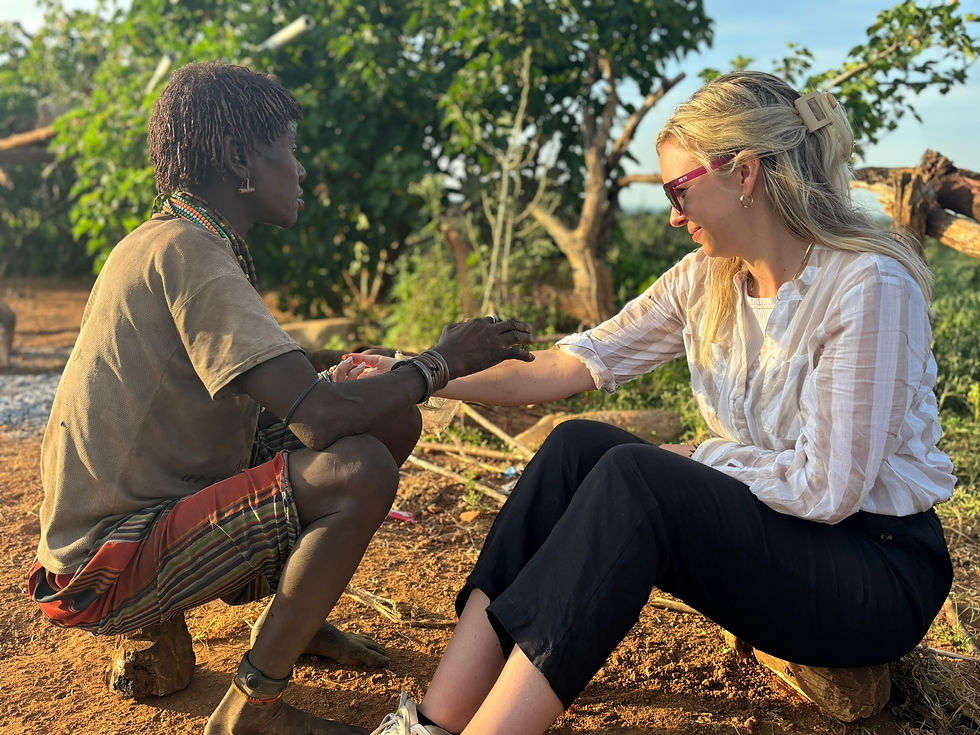
A good experience here doesn’t start with cameras, it starts with time. It is about spending a longer amount of time with one group of people rather than seeing multiple tribes per day for quick surface level interactions. When you do this, you have the time to talk, learn, sit together, take part in daily life. Photography, if it happens, comes naturally after that - not as the reason for being there.
Local people should be actively involved, and they should benefit directly from the experience. Most importantly, they should have real choice in how they participate.
And you should leave feeling like you understand something about life here, not just what it looks like.
Am I here to see people or to meet people?
A lot of the typical tourism experience here moves quickly through villages, ticking off experiences and collecting images.
But the people you meet are not displays. They are families, neighbours, children growing up, people working, joking, resting, living.
The experiences that have stayed with me and our guests have never been about observation. They’ve been about being included for a short time in everyday life, whether that's sharing coffee, making jewellery or picking mohringa leaves.
Who benefits from my visit?
Tourism can be a real source of income in the Omo Valley. It can allow people to stay in their communities and continue living in ways that matter to them, instead of leaving to find other work.
It’s worth asking:
Are local people leading or shaping this experience?
Is money staying in the community?
Are people benefiting directly?
The closer the control stays with local people, the more meaningful and fair the outcome tends to be.

How can I take photos respectfully?
Photography is one of the most sensitive parts of travelling in the Omo Valley, and it’s also where things can easily go awry. Ask before you take a photo and notice the response, not just the words - If someone says no, or seems unsure, or turns away, that is the answer.
Children deserve the same protection and privacy as anyone else, and there is absolutely no place for taking or sharing photos of children in vulnerable situations, including being undressed.
The question I ask myself is not “can I take this photo”, but “would this feel okay if it were me, or my child, in this moment”.
On our tours, there is real connection so photography happens naturally anyway - without needing to push for it.

What actually changes when you spend real time with Hamar people
When visitors spend longer time here, they get to go deeper and they stop feeling like observers and start feeling like guests.
Mornings start slowly, with coffee, conversation, and people drifting in and out of the house. Neighbours arrive, someone brings something to trade, someone sits down to share news, another helps with cooking.
I love learning practical skills - things like milking goats, making fire with sticks, or grinding grain. Things that are so everyday here, but completely unfamiliar to me.
Both myself and our guests struggle with everyday Hamar tasks, like trying to grind sorghum into flour on a traditional stone. It spills everywhere, and everyone ends up laughing. There’s something very humbling about being completely useless at something that is completely normal for everyone else there. I was actually asked 'how have you survived until now without knowing how to grind?'.
There is often far more humour than people expect and it's often slapstick, physical comedy that transcends language barriers! People here laugh easily, including at themselves and each other. One of the most amusing little moments are often children and adults seeing themselves on video or in photos for the first time. I’ve seen a Hamar elder in his 60s look at a video of himself and completely lose it laughing - he couldn’t believe it was him. He kept watching it again and again.
Final Thoughts
The South Omo Valley is an extraordinary place, but it is also a place where tourism needs care. Most tourism in the Omo is focused on observation, ticking off tribes and taking photos.
For me, the South Omo Valley is never really about what I see - it’s about how I’m welcomed into it, even if only for a short time. When you travel with us, you will have the enormous privilege of being be invited into their lives.


Comments